Showing posts with label AWS. Show all posts

Saturday, 1 October 2022

DevOps with serverless Jenkins and AWS CDK


SDET Interview Question and Answers.  

Jenkins Interview Questions and Answers. 

Appium Interview Questions and Answers

Selenium Interview Questions and answers. 

GIT Interview Questions and Answers

DevOps with Serverless Jenkins and AWS CDK

The objective of this post is to walk you through how to set up a completely serverless Jenkins environment on AWS Fargate using AWS Cloud Development Kit (AWS CDK).

Jenkins is a popular open-source automation server that provides hundreds of plugins to support building, testing, deploying, and automation. Jenkins uses a controller-agent architecture in which the controller is responsible for serving the web UI, stores the configurations and related data on disk, and delegates the jobs to the worker agents that run these jobs as their primary responsibility.

Amazon Elastic Container Service (Amazon ECS)  using Fargate is a fully-managed container orchestration service that helps you easily deploy, manage, and scale containerized applications. It deeply integrates with the rest of the AWS platform to provide a secure and easy-to-use solution for running container workloads in the cloud and now on your infrastructure. Fargate is a serverless, pay-as-you-go compute engine that lets you focus on building applications without managing servers. Fargate is compatible with both Amazon ECS and Amazon Elastic Kubernetes Service (Amazon EKS).


Most Used Docker Commands:Interview Question


Solution overview

The following diagram illustrates the solution architecture. The dashed lines indicate the AWS CDK deployment.
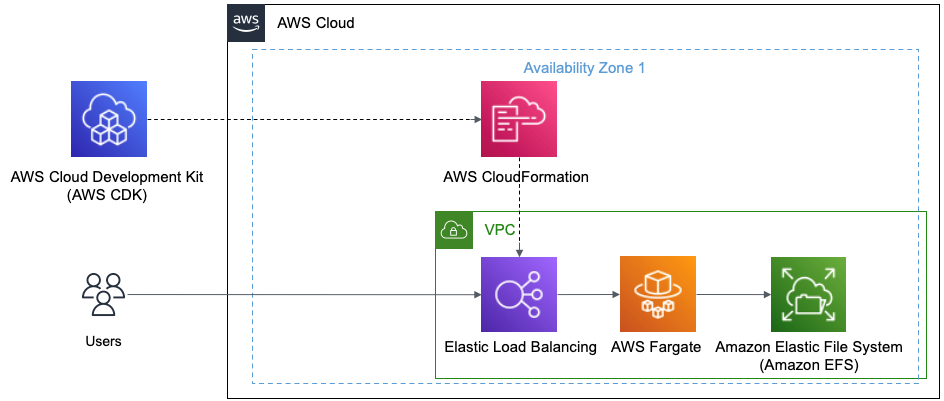
Figure 1 This diagram shows AWS CDK and how it deploys using AWS CloudFormation to create the Elastic Load Balancer, AWS Fargate, and Amazon EFS

Figure 1 This diagram shows AWS CDK and how it deploys using AWS CloudFormation to create the Elastic Load Balancer, AWS Fargate, and Amazon EFS

You’ll be using the following:

  1. The Jenkins controller URL backed by an Application Load Balancer (ALB).
  2. You’ll be using your default Amazon Virtual Private Cloud (Amazon VPC) for this example.
  3. The Jenkins controller runs as a service on Amazon ECS using Fargate as the launch type. You’ll use Amazon Elastic File System (Amazon EFS) as a persistent backing store for the Jenkins controller task. The Jenkins controller and Amazon EFS are launched in private subnets.

Prerequisites

For this post, you’ll utilize AWS CDK using TypeScript.

Follow this guide on Getting Started for AWS CDK to:

  • Get your local environment setup
  • Bootstrap your development account

TOP 50 GIT Interview Q&A


Code

Please review the code used to define the Jenkins environment in AWS using AWS CDK.

Setup your imports

import { Duration, IResource, RemovalPolicy, Stack, Tags } from 'aws-cdk-lib';
import { Construct } from 'constructs';

import * as cdk from 'aws-cdk-lib';

import * as ecs from 'aws-cdk-lib/aws-ecs';
import * as efs from 'aws-cdk-lib/aws-efs';
import { Port } from 'aws-cdk-lib/aws-ec2';
import * as elbv2 from 'aws-cdk-lib/aws-elasticloadbalancingv2';

Setup your Amazon ECS, which is a logical grouping of tasks or services and set vpc

export class AppStack extends Stack {
  constructor(scope: Construct, id: string, props?: cdk.StackProps) {
    super(scope, id, props);

    const jenkinsHomeDir: string = 'jenkins-home';
    const appName: string = 'jenkins-cdk';

    const cluster = new ecs.Cluster(this, `${appName}-cluster`, {
      clusterName: appName,
    });

    const vpc = cluster.vpc;

Setup Amazon EFS to store the data

    const fileSystem = new efs.FileSystem(this, `${appName}-efs`, {
      vpc: vpc,
      fileSystemName: appName,
      removalPolicy: RemovalPolicy.DESTROY,
    });

Setup Access Points, which are application-specific entry points into an Amazon EFS file system that makes it easier to manage application access to shared datasets

const accessPoint = fileSystem.addAccessPoint(`${appName}-ap`, {
      path: `/${jenkinsHomeDir}`,
      posixUser: {
        uid: '1000',
        gid: '1000',
      },
      createAcl: {
        ownerGid: '1000',
        ownerUid: '1000',
        permissions: '755',
      },
    });

Setup Task Definition to run Docker containers in Amazon ECS

const taskDefinition = new ecs.FargateTaskDefinition(
      this,
      `${appName}-task`,
      {
        family: appName,
        cpu: 1024,
        memoryLimitMiB: 2048,
      }
    );

Setup a Volume mapping the Amazon EFS from above to the Task Definition

taskDefinition.addVolume({
      name: jenkinsHomeDir,
      efsVolumeConfiguration: {
        fileSystemId: fileSystem.fileSystemId,
        transitEncryption: 'ENABLED',
        authorizationConfig: {
          accessPointId: accessPoint.accessPointId,
          iam: 'ENABLED',
        },
      },
    });

Setup the Container using the Task Definition and the Jenkins image from the registry

const containerDefinition = taskDefinition.addContainer(appName, {
      image: ecs.ContainerImage.fromRegistry('jenkins/jenkins:lts'),
      logging: ecs.LogDrivers.awsLogs({ streamPrefix: 'jenkins' }),
      portMappings: [{ containerPort: 8080 }],
    });

Setup Mount Points to bind ephemeral storage to the container

containerDefinition.addMountPoints({
      containerPath: '/var/jenkins_home',
      sourceVolume: jenkinsHomeDir,
      readOnly: false,
    });

Setup Fargate Service to run the container serverless

    const fargateService = new ecs.FargateService(this, `${appName}-service`, {
      serviceName: appName,
      cluster: cluster,
      taskDefinition: taskDefinition,
      desiredCount: 1,
      maxHealthyPercent: 100,
      minHealthyPercent: 0,
      healthCheckGracePeriod: Duration.minutes(5),
    });
    fargateService.connections.allowTo(fileSystem, Port.tcp(2049));

Setup ALB and add listeners to checks for connection requests, using the protocol and port that you configure.

    const loadBalancer = new elbv2.ApplicationLoadBalancer(
      this,
      `${appName}-elb`,
      {
        loadBalancerName: appName,
        vpc: vpc,
        internetFacing: true,
      }
    );
    const lbListener = loadBalancer.addListener(`${appName}-listener`, {
      port: 80,
    });

Setup Target to route requests to Jenkins running on Amazon ECS using Fargate

const loadBalancerTarget = lbListener.addTargets(`${appName}-target`, {
      port: 8080,
      targets: [fargateService],
      deregistrationDelay: Duration.seconds(10),
      healthCheck: { path: '/login' },
    });
  }
}

Jenkins Deployment

Now that you have all the code, let’s deploy the AWS CDK definition:

  1. Make sure that you have done the Prerequisite steps from earlier.
  2. Install packages by running the following command in your IDE CLI:
npm i
  1. Now you’ll deploy your AWS CDK definition to your dev account:
cdk deploy

Let’s now login to Jenkins

  1. In your browser, use the DNS Name from the deployed Load Balancer
  2. On Amazon CloudWatch, there will be a Log group that will be created that is associated to Cluster Service.
    1. Go into that log and you’ll see it output the Password to login to Jenkins
  1. In Jenkins, follow the wizard to continue the setup

Cleaning up

To avoid incurring future charges, delete my resources.

Let’s destroy our deploy solution

  1. From your IDE CLI:
cdk destroy

Conclusion

With this overview we were able to cover the following:

  • Build an Elastic Load Balancer
  • Use AWS Fargate with Jenkins AMI
  • All resources running serverlessly
  • All build using AWS CDK


************************************************

✍️AUTHOR: LinkedIn Profile

************************************************

Learn (API-Microservice)Testing+ Selenium UI Automation-SDET with Self Paced Videos prepared by FAANG employee and LIVE Doubt Session 

SDET TRANING VIDEOS AVAILABLE with Live Doubt Session(course-1 below,API TRaining Videos With Class Notes and Coding Set) and (API+UI, both course-1 & 2 below) Check Training Page for Course Content or reach out @whatsapp +91-9619094122. 
This includes classnotes, 300+ interview questions, 3 projects, Java Coding question set for product companies along with career guidance from FAANG employees for Automation and SDET.

For more details whatsapp : https://lnkd.in/dnBWDM33


*************************************************

SeleniumWebdriver Automation Testing Interview Questions:

https://automationreinvented.blogspot.com/search/label/SeleniumWebdriver

API Testing Interview Question Set:

https://automationreinvented.blogspot.com/2022/03/top-80-api-testing-interview-questions.html

DevOps Interview Q&A:

https://automationreinvented.blogspot.com/2021/11/top-11-devops-interview-questions-and.html 

Kubernetes Interview Question Set

https://automationreinvented.blogspot.com/search/label/Kubernetes

Docker Interview Question Set

https://automationreinvented.blogspot.com/Docker

Linux Interview question Set

https://automationreinvented.blogspot.com/search/label/Linux

Automation Testing/SDET Framework Design

https://automationreinvented.blogspot.com/search/label/FrameworkDesign

Java Related Interview Question Set

https://automationreinvented.blogspot.com/search/label/Java

GIT Interview Question Set:

https://automationreinvented.blogspot.com/2021/09/top-40-git-interview-questions-and.html

Coding Interview Question Set:

https://automationreinvented.blogspot.com/search/label/Coding%20Questions

Mobile Testing Interview Question Set:

https://automationreinvented.blogspot.com/search/label/Mobile%20Testing

Python Interview Question Set for QAE - SDET - SDE:

https://automationreinvented.blogspot.com/search/label/Python


Friday, 16 September 2022

What are DevOps Best practices?


SDET Interview Question and Answers.  


Jenkins Interview Questions and Answers. 

Appium Interview Questions and Answers

Selenium Interview Questions and answers. 

GIT Interview Questions and Answers


Most Used Docker Commands:Interview Question


There are a few key practices that help organizations innovate faster through automating and streamlining software development and infrastructure management processes. Most of these practices are accomplished with proper tooling.

One fundamental practice is to perform very frequent but small updates. This is how organizations innovate faster for their customers. These updates are usually more incremental in nature than the occasional updates performed under traditional release practices. Frequent but small updates make each deployment less risky.

 They help teams address bugs faster because teams can identify the last deployment that caused the error. Although the cadence and size of updates will vary, organizations using a DevOps model deploy updates much more often than organizations using traditional software development practices.

Organizations might also use a microservices architecture to make their applications more flexible and enable quicker innovation. The microservices architecture decouples large, complex systems into simple, independent projects. Applications are broken into many individual components (services) with each service scoped to a single purpose or function and operated independently of its peer services and the application as a whole. 

This architecture reduces the coordination overhead of updating applications, and when each service is paired with small, agile teams who take ownership of each service, organizations can move more quickly.

However, the combination of microservices and increased release frequency leads to significantly more deployments which can present operational challenges. Thus, DevOps practices like continuous integration and continuous delivery solve these issues and let organizations deliver rapidly in a safe and reliable manner.

 Infrastructure automation practices, like infrastructure like code and configuration management, help to keep computing resources elastic and responsive to frequent changes. In addition, the use of monitoring and logging helps engineers track the performance of applications and infrastructure so they can react quickly to problems.

Together, these practices help organizations deliver faster, more reliable updates to their customers. Here is an overview of important DevOps practices.


The following are DevOps best practices: 

************************************************

✍️AUTHOR: LinkedIn Profile

************************************************

Learn (API-Microservice)Testing+ Selenium UI Automation-SDET with Self Paced Videos prepared by FAANG employee and LIVE Doubt Session 

SDET TRANING VIDEOS AVAILABLE with Live Doubt Session(course-1 below,API TRaining Videos With Class Notes and Coding Set) and (API+UI, both course-1 & 2 below) Check Training Page for Course Content or reach out @whatsapp +91-9619094122. 
This includes classnotes, 300+ interview questions, 3 projects, Java Coding question set for product companies along with career guidance from FAANG employees for Automation and SDET.

For more details whatsapp : https://lnkd.in/dnBWDM33


Check below link for question and answers with the code:

Top API Interview Question 1-10

Top API INterview Questions 11-20 

Top API AUTOMATION Interview Q&A - 21-30

*************************************************

SeleniumWebdriver Automation Testing Interview Questions:

https://automationreinvented.blogspot.com/search/label/SeleniumWebdriver

API Testing Interview Question Set:

https://automationreinvented.blogspot.com/2022/03/top-80-api-testing-interview-questions.html

DevOps Interview Q&A:

https://automationreinvented.blogspot.com/2021/11/top-11-devops-interview-questions-and.html 

Kubernetes Interview Question Set

https://automationreinvented.blogspot.com/search/label/Kubernetes

Docker Interview Question Set

https://automationreinvented.blogspot.com/Docker

Linux Interview question Set

https://automationreinvented.blogspot.com/search/label/Linux

Automation Testing/SDET Framework Design

https://automationreinvented.blogspot.com/search/label/FrameworkDesign

Java Related Interview Question Set

https://automationreinvented.blogspot.com/search/label/Java

GIT Interview Question Set:

https://automationreinvented.blogspot.com/2021/09/top-40-git-interview-questions-and.html

Coding Interview Question Set:

https://automationreinvented.blogspot.com/search/label/Coding%20Questions

Mobile Testing Interview Question Set:

https://automationreinvented.blogspot.com/search/label/Mobile%20Testing

Python Interview Question Set for QAE - SDET - SDE:

https://automationreinvented.blogspot.com/search/label/Python


All Time Popular Posts

Most Featured Post

𝗦𝘁𝗶𝗹𝗹 𝘀𝘁𝗿𝘂𝗴𝗴𝗹𝗶𝗻𝗴 𝘄𝗶𝘁𝗵 𝗝𝗮𝘃𝗮 𝗰𝗼𝗱𝗶𝗻𝗴 𝗿𝗼𝘂𝗻𝗱𝘀?

❓ 𝗦𝘁𝗶𝗹𝗹 𝘀𝘁𝗿𝘂𝗴𝗴𝗹𝗶𝗻𝗴 𝘄𝗶𝘁𝗵 𝗝𝗮𝘃𝗮 𝗰𝗼𝗱𝗶𝗻𝗴 𝗿𝗼𝘂𝗻𝗱𝘀? The issue isn’t your logic—it’s the lack of pattern recogniti...